The first question that people ask me is, is diabetes a disease or is it a disorder? If diabetes is not controlled, then it starts biting you literally. It can affect your eyes, kidneys, heart, and feet. In fact, we say from the head to the toe can be affected by diabetes.
The Healthy Plate Concept for Diabetes
In the healthy plate concept, what do you do? You have the same thali, no doubt, but now you see, 50 percent of that thali is filled with healthy green leafy vegetables. Now, you got the other half. In that half, divide it into two quarters, and one quarter, as you can see here, is reserved for protein.
Diabetes: Disease or Disorganization?
It can either be a disorganization or it can be a disease, and is left to you to decide how you want to make diabetes. If you just have a little bit of high sugar in your blood and this is reversible or it can be controlled, it’s not going to do any harm to you at all, then why call it a disease?
Diabetes as a Simple Disorder or a Tiger
It’s just a simple disorder and your whole life you can just keep diabetes as just like your friend, and it’s just a simple disorder and it’s not going to affect you in any way. But diabetes is like a tiger.
Diabetes Can Affect the Whole Body
But if you don’t look after diabetes, if diabetes is not controlled, then it starts biting you literally. It can affect your eyes, kidneys, heart, and feet. In fact, we say from the head to the toe, including the head and the toe, can be affected by diabetes.
The Choice in Treating Diabetes
So, ladies and gentlemen, the choice is yours. Do you want to treat diabetes like a simple disorder which may even be completely reversible? You can even remove it from your system or are you going to allow this to grow like a cancer inside your body until ultimately all the organs get affected?
Not Mixing Up Types of Diabetes
So we cannot mix up two types of diabetes because the approach to it is completely different. For example, let me give you just two examples.
Type 1 Diabetes and Insulin Treatment
One is a type of diabetes called type one diabetes. This occurs in children, is an acute onset. Children have very high blood sugars and the only treatment for such children who have this type of type 1 diabetes is insulin.
The Discovery and Impact of Insulin
In fact, you will be surprised to know that insulin itself is discovered only 100 years ago and before that if any child in the world had type 1 diabetes, they simply died within 2 months, 3 months maximum 1 year.
Talking About Type 2 Diabetes
But if we don’t qualify which type of diabetes we are talking about, we are invariably talking about the second type of diabetes which is called type 2 diabetes.
If your father, mother, or both had diabetes, your risk of getting type 2 diabetes is very high, but that is only about 40 percent of the causes. 60 percent of the reason why you get type 2 diabetes is lifestyle related factors and in lifestyle, one of the most important is diet.
Healthy and Unhealthy Diets Related to Diabetes
What you eat. You can see here a very healthy diet shown as well as a very unhealthy diet. The unhealthy diet that you see here is what is going to produce diabetes for you.
Physical Activity and Diabetes Risk
Look at this one, physically active person and a totally physically inactive person. We know that physical inactivity or sedentary behavior is another very important cause of type 2 diabetes.
Focus on Diet in Diabetes Management
In this video, I’m going to spend time on diet, what you can eat, what you should try to limit, and what perhaps you can avoid completely. There is nothing which is totally forbidden but better to avoid certain dietary items.
Indian Diet and Diabetes
And very often people ask me, what are the Indian diets which are good and what are the Indian diets which are not so good?
Now, one of the problems with any Indian diet, whether North India, South India, East India, West India, Central India or the North East of India, that really doesn’t matter.
Carbohydrate Content in Indian Diets
The main problem in the Indian diet vis-a-vis diabetes, type 2 diabetes, is the carbohydrate content. We all eat too much carbohydrate whether it is dosa and idli in the south or chapati or puri in the north.
It really doesn’t matter, it’s how much you eat which is very important. They are all carbohydrates. So, the first principle that you must know in an Indian diet is portion sizes and what you should take.
The Plate Concept for Diet Education
And for that, I find so many books are there, so many articles have been written but I find the simplest way to teach people about diet is to learn about the plate concept that you’re seeing here.
Usual Indian Eating Habits
What you can see here is a thali or a plate and the way we normally eat is shown here where you fill the plate with a lot of rice like a mountain of rice as we call it and then we have, in South India for example, we’ll have rice and sambar, then rice and rasam, then rice and curd and then some other rice item for as dessert also.
Following the Healthy Plate Concept
So, the first thing that you should do is to follow the healthy plate concept which I have shown here.
In the healthy plate concept, what do you do? You have the same thali, no doubt, but now you see 50 percent of that thali is filled with healthy green leafy vegetables.
So, vegetables form half of your plate.
Now, you got the other half. In that half, divide it into two quarters, and one quarter, as you can see here, is reserved for protein and that is what Indians don’t take particularly in South India, the protein intake and therefore the fiber intake is very low.
Vegetable Protein vs Animal Protein
So, vegetable protein is superior to animal protein and there is a lot of data to support this.
However, for a staunch non-vegetarian, if they come and tell me, Doc, you’re telling me not to eat sugar, now you’re telling me to give up non-vegetal, this is too much, I can’t, it’s not worth being a diabetic or not worth living, you know, that’s what they say, it’s such strict non-vegetarians.
Try to avoid red meat.
Egg White and Cholesterol Information
White of the egg white is very good.
You may say why not the yellow? Yellow is also good. It gives you protein but yellow contains cholesterol.
So, if you have taken that one egg, you cannot take cholesterol in any other form.
Whereas you take the egg white, the zero cholesterol, it gives you a lot of protein.
So, you can have your fat in other forms, okay?
So, if you are taking one egg, then that is fine, you have the egg white and the yellow, but the advantage of taking egg white is that you can have four egg whites or five egg whites because there’s zero cholesterol and you’re increasing your protein intake.
So, that second quarter of the plate is reserved for protein.
Carbohydrate Portion on the Plate
Now, you have got the last quarter. That is where your carbohydrate should come in.
Now, there is no need just because you live in the south and your rice is being eaten to change to chapati.
That used to be the old teaching in my father’s days where you know you have rice, change it to chapati, then you won’t eat much in the north.
Oh, you like chapati, so you stop that and take rice.
You know what actually happens?
When you tell them to eat chapati, they’ll eat eight chapatis thinking chapati only, no, I’m not taking rice because all the brain is mind is thinking, I’m not taking rice, I’m not taking rice, I’m not taking rice, so they overeat the chapati and finally the sugar goes up.
If they’re taking the rice, they’ll be more careful.
And so, the opposite in the north as well.
So continue what you like, continue what you are used to, but reserve only a quarter of the plate for that rice or that chapati or any other carbohydrate that you take.
If you do this, this becomes a healthy plate.
Of course, you can add one or two more things.
You have a bowl of curd for example, there are probiotics in it.
If you have a glass of milk, then it gives you a lot of calcium and protein.
So, these are things which you can add on but this plate principle, the healthy principle, every person with diabetes should know.
Fruits and Diabetes
What about fruits?
Again, you can classify fruits into different types.
There are fruits which have a high glycemic index.
The moment you eat the fruit, sugar shoots up.
There are fruits which you take, there is only a gentle increase in the sugar, low glycemic index or medium glycemic index.
Use those fruits.
For example, apple, guava, papaya, orange, watermelon.
These are fruits with not such a high glycemic index and therefore you can take them.
But if you take bananas or if you take mangoes, unfortunately mangoes are so popular especially in the season and I’ve got a full video explaining when to eat mango, how to eat mango, and why a person with diabetes can take mango, but you can’t just take as much mango as you want.
Your sugar is definitely going to go up.
And therefore fruits are good for people without diabetes.
You can take three, four, five fruits a day.
People with diabetes take one fruit a day if your sugar is very well controlled, probably make it two.
But here’s the catch, again, don’t take it as fruit juice.
The moment you take this fruit juice, your sugar will go up because the amount of fruit going in will go up and there is no fiber.
When you just drink it, you don’t get the fiber.
You’ll have to eat the fruit as cut fruit so that you can eat it.
Oils Used in Different Regions
In Chennai, we use gingelly oil or groundnut oil.
In the east and some parts of the north, mustard oil is used.
If you go and tell them, “No, no, for diabetes now you change your oil,” they’ll hate it.
They won’t enjoy their food.
So again, whichever oil you’re using, continue that oil.
But use only limited quantities.
Don’t take huge quantities, whatever is needed for cooking, that oil, continue oil that you are taking.
Functional Foods and Superfoods
Finally, I want to talk about some functional foods or foods which are considered superfoods.
Now, there is a lot of hype about this, a lot of attention in the media, newspapers about different things, and is it true or not that things like garlic, turmeric, and things like ginger, things like that, if you take that they are good for health?
Well, these are food additives and some of them have a positive effect on immunity.
They’re certainly not bad for diabetes and maybe even good for diabetes, but that’s all they are.
Don’t hype them to say that they’re a cure for diabetes.
I’ve seen things saying that you take turmeric and your diabetes will go away.
You know, nothing is so easy in life.
I wish it was.
Then I’ll just be making turmeric and giving it to all my patients and saying that’s enough, don’t come to me, just take turmeric.
Diabetes Control Needs Lifelong Effort
So diabetes reversal, diabetes control needs lifelong effort.
It needs a lot of attention from you.
It needs a lot of discipline, but it’s doable.
So people all the time talk about, oh I’ll reduce my carbohydrate, my diabetes will go away.
For how long will you reduce your carbohydrate?
They even go to zero carbohydrates, keto diet, all kinds of fancy things.
They try to reduce weight because the media and so many organizations are telling them, oh your diabetes will go.
Your diet is going fact.
There are people who say don’t go to a diabetologist.
They’ll just keep on giving you medicine.
Come to us.
We are the saviors.
We will get rid of your diabetes, you know.
And you won’t have work for all the diabetes to close the clinic.
I wish that was true.
I will become a nephrologist or I will become a cardiologist.
That’s what I am dreaming of, that diabetes goes away.
In fact, I used to joke and say, I have a diabetes hospital.
I used to say one day my grandson or great grandson must take people around and say this is a museum where we used to have a disease called diabetes.
That is my dream.
That’s my dream, ladies and gentlemen.
So I’m not saying all of you become diabetic, come to me and I’ll treat you.
I am not saying that.
I am saying diabetes will go away.
But is it easy?
Is it a magic wand like Harry Potter, you know, just waving his wand and diabetes goes away?
I wish it was.
And we have such a want.
Please tell me.
I will also buy it and use it to treat my diabetic patients.
Importance of Diet, Exercise, Medication, and Monitoring
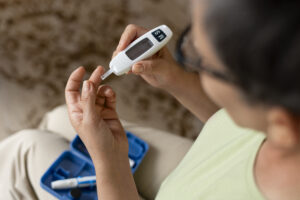
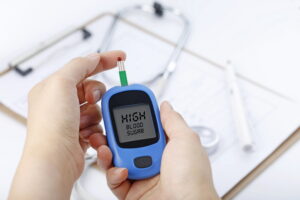
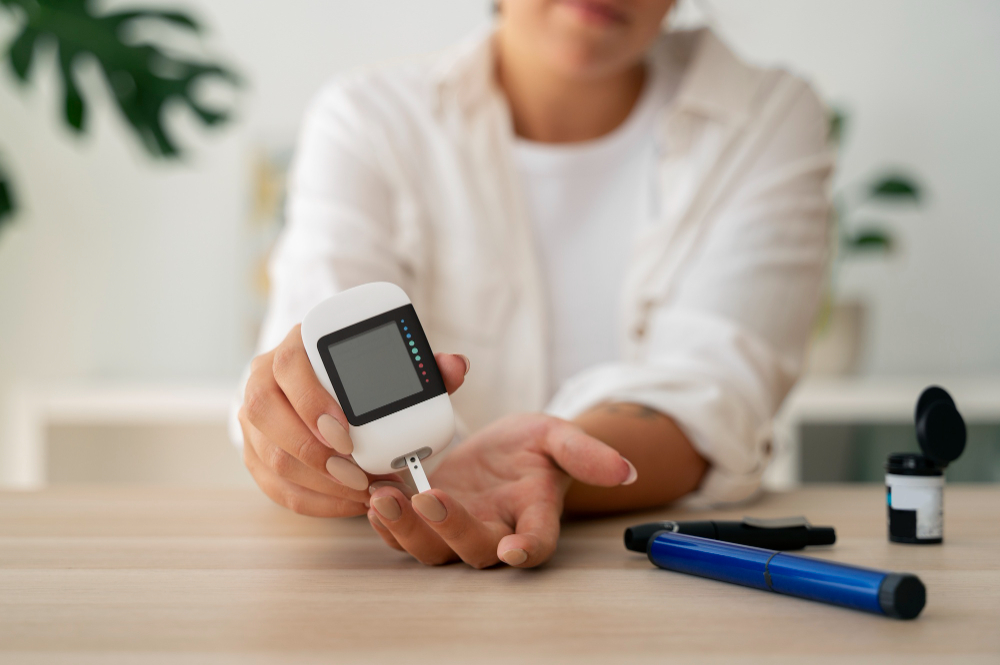
And if you do regular monitoring, looking after your glucose levels either with a glucometer or with a patch which will tell you continuous glucose monitoring, and most importantly, keeping in touch with your doctor because things change in your body.
Because what happens is that today your kidney function may be normal.
Tomorrow, heaven forbid, your kidney function changes, it worsens, then the entire treatment will have to be changed.
So these media people who keep saying and on social media people can, don’t go to doctors, you can google and get your medicine and take it yourself, well best of luck to you if you believe in that.
But there’s a danger associated with it.
All of us didn’t study medicine for so many years.
We can also learn google.
I can teach my grandson to google better and become a google doctor.
It’s, I wish life was so easy.
It is not so.
Look after yourself.
It is my hope and prayer that all of you live up to 100 years without any complications.
But for that, as the main theme of today is on diet, I would say diet plays a very important role.
Closing Remarks and Further Videos
I hope you enjoyed this article where we talked quite extensively about diet.
You will find in my channel many other articles related to other aspects of diet, about exercise, about lifestyle, about sleep, about do’s and don’ts that a person with diabetes should do.